How dry ice cleaning works: a look behind the technology


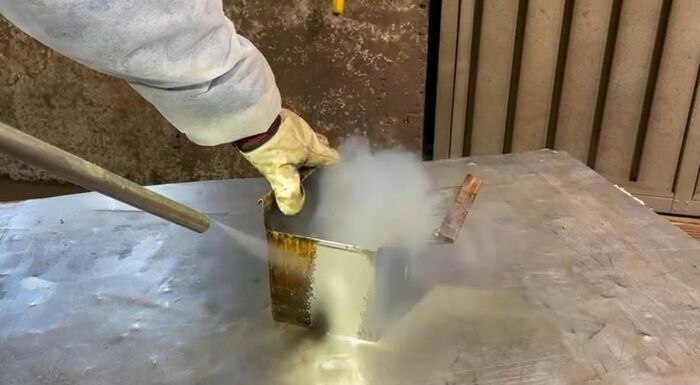
Dry ice cleaning is a modern, environmentally friendly and highly effective method of removing dirt, deposits and residues from a wide variety of surfaces. But how exactly does this process work without water, chemicals or mechanical abrasion? In this article, we take a detailed look at the technology behind dry ice cleaning – and show why it has proven itself in so many industries.
The basis: dry ice pellets made from CO₂
Dry ice is carbon dioxide (CO₂) in solid form, processed into pellets at -78.5 °C. These pellets are odourless, non-toxic and leave no residue. In cleaning technology, they are blasted onto the surfaces to be treated using compressed air. At first glance the principle resembles sand or water blasting, but with one crucial difference: dry ice is non-abrasive and vaporises instantly on impact – a process known as sublimation.
The cleaning effect: physics instead of chemistry
The cleaning action of dry ice blasting is based on three physical effects:
Kinetic energy: the pellets strike the surface at high speed, loosening loose particles and dirt.
Thermal shock: the temperature difference between the -78.5 °C pellets and the surface creates stresses that break up stubborn contamination.
Sublimation effect: the dry ice changes directly into a gas and expands considerably – this effect further helps to detach residues.
This threefold mechanism ensures thorough yet gentle cleaning, even on sensitive materials.
Advantages over conventional cleaning methods
Compared with wet cleaning, sandblasting or chemical cleaning, dry ice cleaning offers numerous advantages:
No moisture: ideal for use on electrical components or in sensitive production environments.
Residue-free cleaning: there is no secondary waste and no additional cleaning residue.
Gentle on materials: as there is no abrasion, even sensitive surfaces remain undamaged.
Time-saving: many systems can be cleaned without being dismantled – saving downtime and costs.
Environmentally friendly: no solvents or chemicals are needed. The CO₂ used often comes from industrial recovery and places no additional burden on the climate.
A wide range of applications
Thanks to its flexibility, dry ice cleaning is suitable for numerous industries:
Automotive industry: cleaning moulds, tools, body parts and production equipment.
Food industry: hygienic cleaning of machines, conveyor systems and packaging lines.
Electronics and mechanical engineering: removing oils, grease, dust and particles without damage.
Heritage conservation: gentle cleaning of façades, sculptures and historic materials.
polarjet: technology leader in dry ice cleaning
The polarjet brand stands for innovative technology, top quality and maximum versatility. polarjet dry ice cleaning machines are characterised by precise control, robust construction and optimum energy efficiency. Depending on the application, blasting pressure, pellet size and air volume can be individually adjusted – for a tailor-made cleaning solution in every industry.
With mobile machines such as the polarjet 1600 or more powerful models for industry, the company offers solutions for every requirement – from pinpoint use in electronics manufacturing to large-scale cleaning of production plants.
Conclusion: a cleaning technology with a future
Dry ice cleaning is more than just an alternative – it is the future of industrial cleaning. It combines sustainability, efficiency and safety in a process that can be flexibly adapted to the needs of a wide range of industries. Companies that want to rely on modern cleaning methods will find polarjet a reliable partner with many years of experience and a technological edge.